Blocks
Block definitions, shapes, registries, and the Face constant.
BlockDefinition
Authoring form of a block, accepted by BlockRegistry.register() and the engine's blocks option. Only id, name, and shapeId are required.
export interface BlockDefinition {
  /** Unique numeric identifier, 1 or above. See [Air](#air). */
  id: number;
  /** Human-readable name for editor display. */
  name: string;
  /** ID of the BlockShape to use for geometry generation. */
  shapeId: BlockShapeID;
  /**
   * Per-face tile references.
   * If a face is absent, defaultTexture is used.
   * @default {}
   */
  faceTextures?: Partial<Record<FACE, TileRef>>;
  /** Fallback tile used for any face not listed in faceTextures. */
  defaultTexture?: TileRef;
  /**
   * If false, the mesh builder will not emit
   * collision geometry for this block.
   * @default true
   **/
  collidable?: boolean;
  /**
   * Set it on any block you can see through.
   * A transparent block never hides a neighbouring face.
   * @default false
   */
  transparent?: boolean;
  /** Fills in any tile ref that omits a tileset. Dropped once resolved. */
  defaultTilesetId?: string;
}
So a solid untextured block is:
registry.register({ id: 1, name: "Stone", shapeId: "cube" });A TileRef may be a bare [col, row] tuple; resolution expands it and applies defaultTilesetId to any ref that omits a tileset.
Air
const AIR_BLOCK_ID = 0;
function isAir(blockId: number): boolean;
Id 0 is reserved: a cell holding air holds no voxel at all. Nothing stores it, so both ends of the invariant throw rather than accept it.
BlockRegistry.register()(and the constructor, which routes through it) throws anErroron a definition with id0.packVoxel()throws aRangeError, which takes every write path with it:VoxelChunk.set(),VoxelLayer.setVoxelAt(),VoxelWorld.setVoxelAt()andVoxelEngine.setVoxel().
Erase a voxel with removeVoxel(); setting it to air is not a supported alternative. On the read side, air is a missing entry: undefined from getVoxelAt(), VOXEL_ABSENT from the packed accessors.
ResolvedBlockDefinition
What BlockRegistry stores and every consumer reads: defaults applied, every tile reference an object, and no defaultTilesetId.
export type ResolvedBlockDefinition =
  & Omit<
    BlockDefinition,
    "faceTextures" | "defaultTexture" | "collidable" | "defaultTilesetId"
  >
  & {
    faceTextures: Partial<Record<FACE, ResolvedTileRef>>;
    defaultTexture?: ResolvedTileRef;
    collidable: boolean;
  };
resolveBlockDefinition(def: BlockDefinition): ResolvedBlockDefinition
Returns a new definition; def and its tile references are never mutated. BlockRegistry.register() calls it for you.
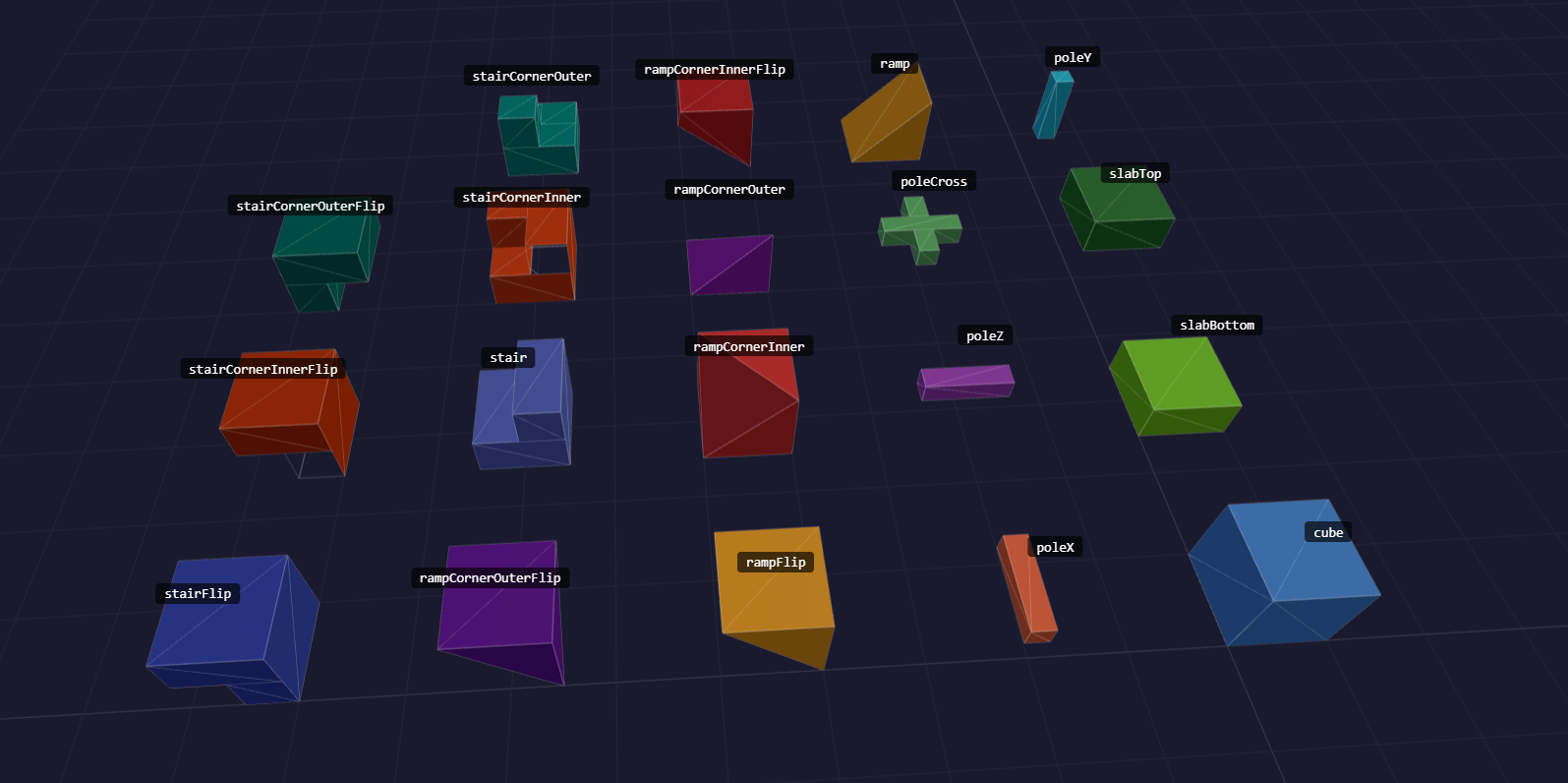
BlockShapeID
type BlockShapeID =
  | "cube"
  | "slabBottom"
  | "slabTop"
  | "poleY"
  | "pole"
  | "ramp"
  | "rampCornerInner"
  | "rampCornerOuter"
  | "stair"
  | "stairCornerInner"
  | "stairCornerOuter"
  | (string & {}); // custom shapes registered at runtime
The
(string & {})tail means any string compiles, but unknown IDs fail silently at runtime — the voxel is skipped. Always use a built-in ID or one registered viaBlockShapeRegistry.register().
BlockCollisionHint
type BlockCollisionHint = "box" | "trimesh" | "none";"box"— compound cuboids; one per solid voxel. Cheapest; best for full-cube worlds."trimesh"— exact triangle mesh built from rendered geometry. Accurate for slopes; may ghost-collide on shared edges."none"— no collision geometry. Use for decorative or trigger blocks.
See Collision for more information.
FaceDefinition
Geometry descriptor for one polygonal face of a block shape.
interface FaceDefinition {
  /** Axis-aligned culling direction used to find the neighbor to check. */
  face: FACE;
  /** Outward-pointing surface normal (need not be axis-aligned). */
  normal: Vec3;
  /** 3 (triangle) or 4 (quad) positions in 0-1 block space. */
  vertices: readonly Vec3[];
  /** Same count as vertices; UV coordinates in 0-1 tile space. */
  uvs: readonly Vec2[];
}
A quad is triangulated as [0,1,2] + [0,2,3].
BlockShape
Interface implemented by all shape classes.
interface BlockShape {
  readonly id: BlockShapeID;
  readonly faces: readonly FaceDefinition[];
  readonly collisionHint: BlockCollisionHint;
  occludes(face: Face): boolean;
}
occludes(face) returns true only when the shape fully covers the given face, allowing the mesh builder to skip the opposite face on the neighbour. Partial shapes (ramps, wedges) must return false to avoid incorrect face culling.
BlockRegistry
Maps numeric block IDs to ResolvedBlockDefinition objects. Accessible via VoxelEngine.blockRegistry.
register(def: BlockDefinition): this
Registers a block definition, filling the defaults documented on BlockDefinition. Throws on AIR_BLOCK_ID, see Air.
get(id: number): ResolvedBlockDefinition | undefined
has(id: number): boolean
getAll(): IterableIterator<ResolvedBlockDefinition>
[Symbol.iterator](): IterableIterator<ResolvedBlockDefinition>
Same iterator as getAll(), so the registry can be spread or used directly in a for...of loop.
readonly nextId: number
Identifier to give the next block, one above the highest ever registered. Never 0 (air), and never reuses the gap a removed block left behind, so an id stays tied to the block it was minted for.
Not clamped to MAX_BLOCK_ID; a world holding that many blocks fails later, when the voxel is packed.
readonly version: number
Incremented on every register(). The mesh builder precompiles geometry per block and uses this to notice that its cache went stale.
BlockShapeRegistry
Maps shape IDs to BlockShape implementations. Pre-populated with all built-in shapes by VoxelEngine. Accessible via VoxelEngine.shapeRegistry.
register(shape: BlockShape): this
get(id: BlockShapeID): BlockShape | undefined
has(id: BlockShapeID): boolean
getAll(): IterableIterator<BlockShape>
Every registered shape, in registration order.
ids(): IterableIterator<BlockShapeID>
IDs of every registered shape, in registration order.
[Symbol.iterator](): IterableIterator<BlockShape>
Same iterator as getAll(), so the registry can be spread or used directly in a for...of loop.
readonly version: number
Incremented on every register(); see BlockRegistry.version.
static createDefault(): BlockShapeRegistry
Creates a standalone registry pre-loaded with all built-in shapes.
Face
Axis-aligned face directions used for culling decisions and per-face texture references.
const Face = {
  PosX: 0, // +X
  NegX: 1, // -X
  PosY: 2, // +Y (top)
  NegY: 3, // -Y (bottom)
  PosZ: 4, // +Z
  NegZ: 5  // -Z
} as const;

type Face = typeof Face[keyof typeof Face];