BlockShape
A shape is the geometry a block draws and collides with, named by BlockDefinition.shapeId. Every VoxelView registers the built-in shapes in view.shapes; add your own with the shapes view option or view.shapes.register(). See creating custom shapes for a full example.
interface BlockShape {
  readonly id: BlockShapeID;
  readonly faces: readonly FaceDefinition[];
  readonly collisionHint: BlockCollisionHint;

  occludes(face: Face): boolean;
}

type BlockShapeID = "cube" | "slabBottom" | ... | (string & {});
type BlockCollisionHint = "box" | "trimesh" | "none";
BlockShapeID lists the built-in ids but accepts any string. A block naming an unregistered shape is not drawn.
occludes(face) returns true when the shape covers that whole side of its cell, which hides the neighbour's face against it. Return false for partial coverage: a wrong true removes visible geometry from the neighbour.
collisionHint picks the collider a VoxelCollider builds: a box, a triangle mesh of the faces, or nothing.
Built-in shapes
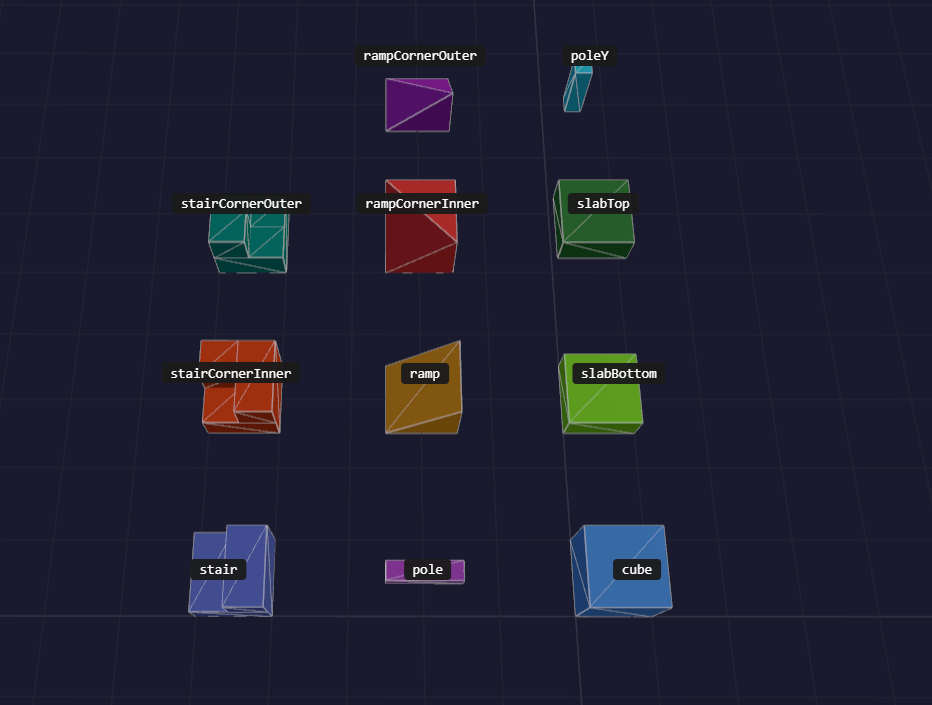
| Shape id | Class | Collision | Occludes | Texture slots |
|---|---|---|---|---|
cube | new Cube(id?) | box | all | six faces |
slabBottom | new Slab("bottom", id?) | box | NegY | six faces |
slabTop | new Slab("top", id?) | box | PosY | six faces |
slabBeam | new Slab("beam", id?) | box | none | six faces |
slabCorner | new Slab("corner", id?) | box | none | six faces |
slabNotch | new Slab("notch", id?) | trimesh | none | adds left.1, back.1 |
wall | new Wall("straight", id?) | box | none | six faces |
wallCorner | new Wall("corner", id?) | trimesh | none | adds right.1, front.1 |
wallTee | new Wall("tee", id?) | trimesh | none | adds right.1, front.1, back.1 |
wallCross | new Wall("cross", id?) | trimesh | none | adds a .1 slot on each side |
poleY | new PoleY(id?) | box | none | six faces |
pole | new Pole("straight", "none", id?) | box | none | six faces |
poleCorner | new Pole("corner", "none", id?) | trimesh | none | adds right.1, front.1 |
poleTee | new Pole("tee", "none", id?) | trimesh | none | adds right.1, front.1, back.1 |
poleCross | new Pole("cross", "none", id?) | trimesh | none | adds a .1 slot on each side |
poleEndUp | new Pole("end", "up", id?) | trimesh | none | adds top.1, front.1 |
poleUp | new Pole("straight", "up", id?) | trimesh | none | adds top.1, front.1, back.1 |
poleCornerUp | new Pole("corner", "up", id?) | trimesh | none | adds right.1, top.1, front.1 |
poleTeeUp | new Pole("tee", "up", id?) | trimesh | none | adds right.1, top.1, front.1, back.1 |
poleCrossUp | new Pole("cross", "up", id?) | trimesh | none | adds a .1 slot on each side but bottom |
poleEndThrough | new Pole("end", "through", id?) | trimesh | none | adds top.1, bottom.1, front.1 |
poleThrough | new Pole("straight", "through", id?) | trimesh | none | adds top.1, bottom.1, front.1, back.1 |
poleCornerThrough | new Pole("corner", "through", id?) | trimesh | none | adds right.1, top.1, bottom.1, front.1 |
poleTeeThrough | new Pole("tee", "through", id?) | trimesh | none | adds a .1 slot on each side but left |
poleCrossThrough | new Pole("cross", "through", id?) | trimesh | none | adds a .1 slot on each side |
ramp | new Ramp(id?) | trimesh | NegY, PosZ | no back |
rampCornerInner | new RampCornerInner(id?) | trimesh | NegY, PosZ, PosX | six faces |
rampCornerOuter | new RampCornerOuter(id?) | trimesh | NegY | no top |
rampTip | new RampTip(id?) | trimesh | none | no right, front |
rampValley | new RampValley(id?) | trimesh | PosX, PosY, NegZ | no bottom; adds left.1, front.1 |
stair | new Stair(id?) | trimesh | NegY, PosZ | adds top.1, back.1 |
stairCornerInner | new StairCornerInner(id?) | trimesh | NegY, PosZ, PosX | adds left.1, top.1, back.1 |
stairCornerOuter | new StairCornerOuter(id?) | trimesh | NegY | adds right.1, top.1, front.1 |
stairCornerPeak | new StairCornerPeak(id?) | trimesh | none | adds right.1, top.1, front.1 |
Slab takes a SlabType ("bottom" | "top" | "beam" | "corner" | "notch", default "bottom"). A beam is half a bottom slab, a corner a quarter, and a notch three quarters, the missing quarter at the -X, -Z corner. The six face slots are right, left, top, bottom, front and back; see texture slots.
Wall takes a WallType ("straight" | "corner" | "tee" | "cross", default "straight") and builds a full-height wall a quarter block thick, centered in the cell. Pole takes a PoleType with the same values, default "straight", and a PoleRise ("none" | "up" | "through", default "none") that adds an arm to +Y, or arms to both +Y and -Y. With a rise, the type may also be "end": a single horizontal arm to +Z. Walls and horizontal poles run along Z: a corner branches to +Z and +X, a tee adds a +X arm to a straight piece, and a cross runs along both axes. Every arm ends on the same section as pole or poleY, so joined blocks hide the faces they share. A rise placed with flipY: true points down.
stairCornerPeak is a full-height quarter column standing on an L-shaped lower step, with the opposite quarter left empty. The column sits where stairCornerOuter puts its upper step.
Ceiling ramps and upside-down stairs are the same shapes placed with flipY: true, see VoxelTransform.
Complements
Each shape below has a complement that fills the rest of its cell. Placed with the original's transform, the pair forms a full cube. A flipped complement toggles flipY; a flipped and turned one also turns rotation by two more quarter turns.
| Shape | Complement |
|---|---|
slabBottom | slabTop |
stair | slabBeam, flipped |
stairCornerInner | slabCorner, flipped |
stairCornerOuter | slabNotch, flipped |
stairCornerPeak | stairCornerPeak, flipped and turned |
ramp | ramp, flipped and turned |
rampCornerInner | rampTip |
rampCornerOuter | rampValley |
slabBeam, slabCorner and slabNotch rest on the floor like slabBottom, so their stair complement is the flipped piece.
A shape and its complement can share one cell, see merged cells. Complements are found from the geometry, so custom shapes pair up without declaring anything:
class ShapeOccupancy {
  static fromShape(shape: BlockShape, transform?: VoxelTransform): ShapeOccupancy;
  complements(other: ShapeOccupancy): boolean;
  contains(point: Vec3): boolean;
}

class BlockComplements {
  constructor(options: { blocks: BlockRegistry; shapes: BlockShapeRegistry });
  complements(a: PackedVoxel, b: PackedVoxel): boolean;
  resolveOccupancy(packed: PackedVoxel): ShapeOccupancy | null;
}
ShapeOccupancy.fromShape() samples which parts of the cell a placed shape fills and caches the result per shape and transform. Two occupancies complement each other when they never overlap, leave no gap, and together cover all six sides of the cell. BlockComplements answers the same question for two placed blocks; an unknown block or shape is never a complement.
contains() tests one point exactly, in cell space (0..1 on each axis), against the placed faces rather than the samples. A point on a face may go either way. resolveOccupancy() returns the occupancy of a placed block, or null when its block or shape is unknown.
BlockShapeBase
abstract class BlockShapeBase implements BlockShape {
  abstract readonly id: BlockShapeID;
  abstract readonly faces: readonly FaceDefinition[];
  abstract readonly collisionHint: BlockCollisionHint;

  occludes(face: Face): boolean;
}

function computeOcclusionMask(faces: readonly FaceDefinition[]): number;
function computeSideCoverage(faces: Iterable<FacePlacement>): Float64Array;
Derives occludes() from faces: a side occludes when the faces lying on its boundary plane cover the whole unit square. Faces sharing a side must not overlap, or their areas add up and the side reports covered when it is not. Override occludes() when the geometry does not tell the truth, for example a full quad drawn through an alpha mask. computeOcclusionMask() returns the same answer as a bitmask indexed by Face, and computeSideCoverage() the covered area of each side, indexed by Face. Every built-in shape extends this class.
BlockShapeRegistry
class BlockShapeRegistry implements Iterable<BlockShape> {
  readonly version: number;

  static createDefault(): BlockShapeRegistry;
  register(shape: BlockShape): this;
  registerMany(shapes: Iterable<BlockShape>): this;
  get(id: BlockShapeID): BlockShape | undefined;
  has(id: BlockShapeID): boolean;
  getAll(): IterableIterator<BlockShape>;
  ids(): IterableIterator<BlockShapeID>;
}
register() replaces a shape with the same id. Iteration follows registration order. version increases on each registration. createDefault() returns a registry holding the built-in shapes.
Faces
interface FaceDescriptor {
  face: Face;
  normal: [number, number, number];
  vertices: readonly [number, number, number][];
  uvs?: readonly [number, number][];
  cull?: Face | null;
  slot?: string;
}

interface FaceDefinition {
  readonly face: Face;
  readonly normal: [number, number, number];
  readonly vertices: readonly [number, number, number][];
  readonly uvs: readonly [number, number][];
  readonly cull: Face | null;
  readonly slot?: string | null;
  readonly span?: Readonly<TileSpan>;
}

function defineFace(descriptor: FaceDescriptor): FaceDefinition;defineFace({
face: Face.PosZ,
normal: [0, 0, 1],
vertices: [[0, 0, 1], [1, 0, 1], [1, 1, 1], [0, 1, 1]]
});A face has three or four vertices in block space, 0 to 1 on each axis. face is the side it belongs to, which picks its texture slot and its default culling. defineFace() fills in uvs, cull and span. slot pins the face to a named texture slot, see pinning a slot.
const Face = {
  PosX: 0, NegX: 1, PosY: 2, NegY: 3, PosZ: 4, NegZ: 5
} as const;
Default culling
interface FacePlacement {
  face: Face;
  vertices: readonly [number, number, number][];
}

function isBoundaryFace(placement: FacePlacement): boolean;
function defaultCullFace(placement: FacePlacement): Face | null;
When cull is omitted, a face whose vertices all lie on its side's boundary plane is culled against that side, and any other face is never culled. defaultCullFace() returns that value. Pass cull: null to never cull a face, or another side to cull against it instead.
Face UV convention
When uvs is omitted, each vertex is projected onto its face, seen from outside the block, with u to the right and v up:
| Face | u | v |
|---|---|---|
PosX | 1 - z | y |
NegX | z | y |
PosY | 1 - x | z |
NegY | 1 - x | 1 - z |
PosZ | x | y |
NegZ | 1 - x | y |
A face samples only the part of the tile it covers: a pole side spans u0.375 to 0.625, a slabBottom side spans v 0 to 0.5. One texture therefore continues across neighbouring blocks of different shapes. projectFaceUv(face, vertex) and faceUvs(face, vertices) compute the projection. Pass explicit uvs to repeat or rotate a tile on purpose.
Slanted faces
function faceUvSpan(
  face: Face,
  normal: [number, number, number]
): Readonly<TileSpan>;
A ramp slope is √2 blocks long but its UVs span 0 to 1. faceUvSpan() returns the tiles the face really covers, { u: 1, v: √2 } for a ramp slope, and defineFace() stores it as span. A face given explicit uvs, or leaning along both axes, keeps { u: 1, v: 1 }.